Asian Handicap is a form of football betting that removes the draw as an outcome and applies a virtual goal advantage or deficit to each team. The result is a two-outcome market (either team covers their handicap or they do not) which typically offers better value than the standard win/draw/win market.
It sounds more complicated than it is. Once the structure clicks, most bettors find it straightforward.
---
The basics: why handicaps exist
In a standard 1X2 market, betting on a strong favourite to win might return 1.30 or less. There is not much value there. Asian Handicap solves this by asking a more demanding question: can the favourite win by enough?
A handicap gives the underdog a virtual head start. The favourite must overcome that head start for your bet to win. In return, the odds are more competitive.
---
Whole and half-line handicaps
Half-line handicaps are the simplest form. There are no draws and no refunds.
Example: Chelsea -1.5 vs Burnley +1.5. If you back Chelsea at -1.5, they must win by two goals or more. A 1-0 win is not enough. If you back Burnley at +1.5, they can lose by one goal and you still win.
Because the handicap is a half goal, there is no possibility of a push. Every bet either wins or loses.
Whole-line handicaps work the same way but allow for a push (a refund) when the match ends exactly on the handicap line.
Example: Chelsea -1. If Chelsea win by exactly one goal, your stake is returned. Win by two or more, you win the bet. They draw or lose, you lose.
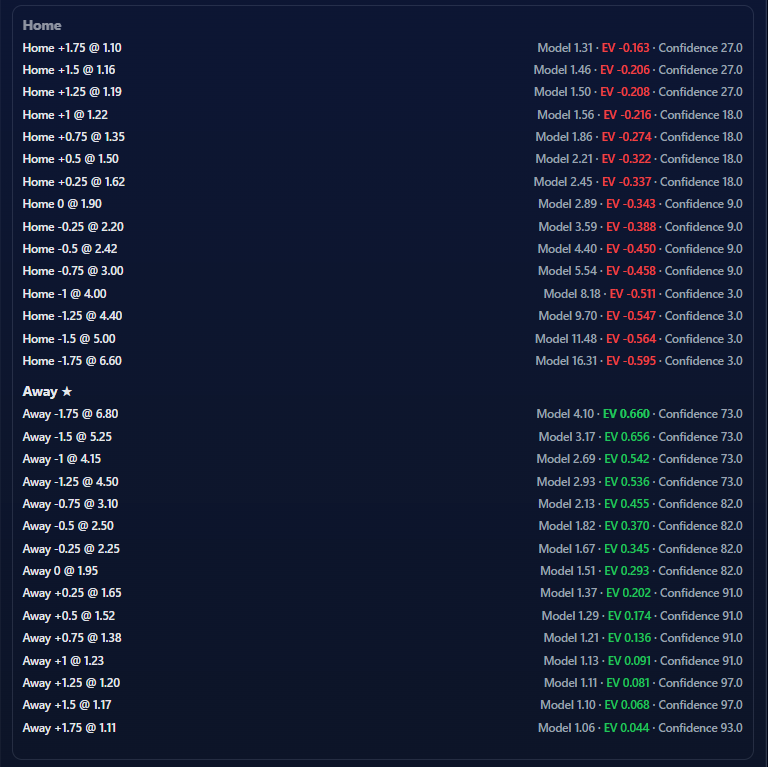
Quarter-line handicaps split your stake across the two adjacent whole/half lines. A -1.25 handicap puts half your stake on -1 and half on -1.5. If Chelsea win by exactly one goal, half the bet is refunded (the -1 portion) and the other half loses (the -1.5 portion). Win by two or more and both halves win.
!image
---
How to read Asian Handicap odds
Asian Handicap odds are expressed in decimal format. The key difference from a standard market is that you are pricing a two-way outcome, so odds are typically closer to evens (2.00) than in a 1X2 market.
When a line is set around 0.5 (sometimes called the pick 'em), the bookmaker sees the match as roughly even. Negative handicaps favour the home side; positive handicaps favour the away side.
---
Why Asian Handicap often offers better value
Bookmakers build a margin into every market. In a 1X2 market, that margin is spread across three outcomes. In an Asian Handicap market, it is spread across two. Mathematically, the margin per outcome is often lower, which means better implied probabilities for the bettor.
For favourites in particular, Asian Handicap can return significantly better odds than the straight win market.
---
How BetSignals models Asian Handicap
BetSignals calculates the fair Asian Handicap line for each fixture by using the model's full score matrix. It finds the handicap line closest to a 50% cover probability for the favoured side, in other words, the line where the bet is a coin flip based on the model's view of the match.
If the bookmaker's offered line is more favourable than the model's fair line, that represents a potential edge. The Asian Handicap probability and suggested line are shown on every fixture alongside the win and goal market data.
---
When Asian Handicap is most useful
Backing strong favourites. Rather than taking 1.30 on a straightforward win, a -1 or -1.5 handicap on the same team might return 1.85 or better.
Backing underdogs without needing a win. A +1 on the away side means you win even if they lose by a narrow margin. You are asking less of the underdog than a straight win bet would.
Removing the draw. If you think a team will not lose but the draw odds are unappealing, a 0 line (pick 'em) Asian Handicap returns your stake on a draw rather than losing it.
---
Next reads
- How Football Odds Work: the foundations before applying handicap thinking
- Implied Probability Explained: how to convert odds into a probability to compare against the model
- What is a Value Bet?: using the model's AH line to identify edge
---
18+ | Gambling should be enjoyable. If it stops being fun, take a break. For support and advice visit BeGambleAware.org. See our full responsible gambling guide.