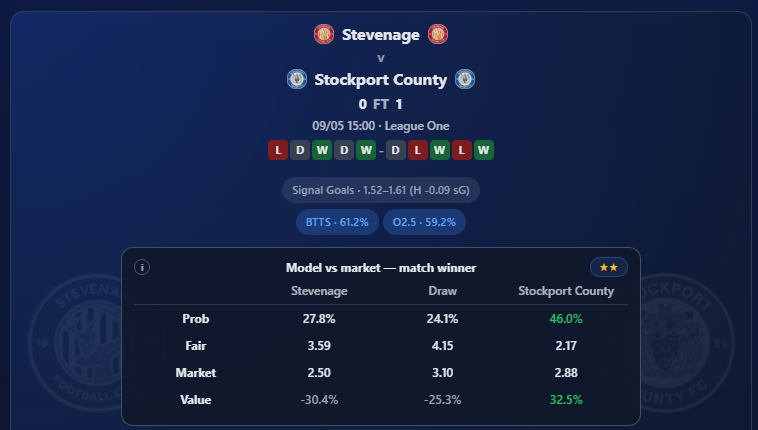
Expected value is the average return you would receive per pound staked if you placed the same bet an infinite number of times. It tells you, in one number, whether a bet is mathematically worth taking.
A positive EV bet returns more than it costs on average. A negative EV bet costs more than it returns. Most bets placed by casual punters are negative EV, the bookmaker's margin ensures it.
---
The formula
EV = (Probability of winning × profit per pound) minus (Probability of losing × stake per pound)
For a £1 stake at decimal odds of 2.50, where you assess the true probability at 50%:
- Probability of winning: 0.50
- Profit if win: £1.50 (odds of 2.50 minus your £1 stake)
- Probability of losing: 0.50
- Loss if lose: £1.00
EV = (0.50 × 1.50) − (0.50 × 1.00) = 0.75 − 0.50 = +0.25
A positive EV of 0.25 means for every £1 staked, you expect to return 25p profit on average over many repetitions. This is a value bet.
---
A simplified version
Since you always risk £1 to win (odds − 1), the formula simplifies to:
EV = (Your probability × decimal odds) − 1
Using the same example: (0.50 × 2.50) − 1 = 1.25 − 1 = +0.25
If the result is positive, the bet has positive EV. If negative, you are paying more than the bet is worth.
---
Why most bets are negative EV
Bookmakers set prices to guarantee themselves a profit regardless of outcome. They do this by pricing all outcomes in a market so that the total implied probabilities add up to more than 100%. The excess is their margin, effectively a tax on every bet placed.
In a 1X2 market with a typical 5% margin, even if you had no edge whatsoever in your selections, you would lose 5% of your staked money over time. Most casual bettors have a negative edge on top of that. The combined result is that the vast majority of recreational betting is a losing activity over any meaningful time period.
This is not pessimism. It is arithmetic. Understanding it is what motivates a structured, probability-first approach.
---
How to use EV in practice
You need two inputs: your probability estimate and the decimal odds.
1. Estimate the probability of the outcome as honestly as you can, using data. See how the BetSignals model works for a data-led way to do this.
2. Calculate the implied probability from the odds: 1 ÷ decimal odds
3. If your probability is higher than the implied probability, the EV is positive
4. Calculate EV using the formula above to see how large the edge is
If EV is positive, the bet is mathematically worth taking at that price. The larger the positive EV, the stronger the case for acting.
---
EV and the long run
Expected value is a long-run concept. On any individual bet, EV tells you nothing about whether it will win. A +0.30 EV bet will still lose roughly as often as the probability suggests.
The power of EV is in accumulation. If you place 200 bets per season each with an EV of +0.10 (10p expected profit per £1 staked), your expected annual profit is 200 × £0.10 × average stake. The variance from individual results smooths out over enough bets.
This is why bankroll management matters alongside EV. Positive EV only helps you if you stay in the game long enough for the law of large numbers to work. Reckless staking can wipe out a bankroll before your edge has time to express itself.
---
EV on BetSignals
BetSignals computes expected value for each market using the model's probability estimates against the best available bookmaker odds. This gives you a direct read on whether any given signal has positive EV at current prices, without having to run the maths yourself every time.
Signals with a meaningful positive EV and strong model agreement (★★★) represent the clearest combination of data confidence and mathematical edge.
---
Next reads
- What is a Value Bet?: the conceptual foundation for EV thinking
- Understanding Edge Percentage: expressing EV as a percentage of stake
- Implied Probability Explained: converting odds to probability, the prerequisite for every EV calculation
---
18+ | Gambling should be enjoyable. If it stops being fun, take a break. For support and advice visit BeGambleAware.org. See our full responsible gambling guide.